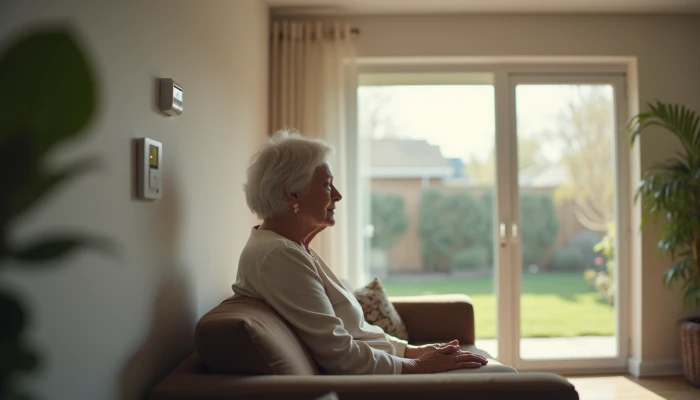
How to Add Home Monitoring Without Making Home Feel Watched
For many families, home monitoring seems like a simple way to support aging at home. The harder part is deciding how to add it without making an older adult feel observed, controlled, or pushed out of decisions about their own home.
That tension is real. Safety matters, especially when families worry about falls, wandering, missed routines, or emergencies. But privacy matters too. For many older adults, independence is not just about staying in the home. It is also about keeping choice, dignity, and personal space.
A thoughtful approach can help. Research and implementation guidance commonly point to the same idea: monitoring works better when it is person-centered, limited to a clear purpose, and designed around the older adult's comfort level. In practice, that often means starting with less intrusive tools, being clear about what is being monitored, and agreeing on when alerts should happen and who can see them.
Understanding Privacy Concerns in Senior Monitoring
Privacy concerns are not a side issue in senior monitoring. They are often the main reason a system is accepted, rejected, or quietly ignored after installation.
Reviews of smart home surveillance research among adults age 50 and older consistently highlight a few recurring concerns: loss of autonomy, uncertainty about who can access data, discomfort with feeling watched, and worries that convenience for caregivers could come at the expense of dignity for the person living at home.
Older adults do not all define privacy the same way. One person may be comfortable with a door sensor but strongly object to indoor cameras. Another may accept a wearable alert button but dislike location tracking. Someone with memory changes may value extra support on some days and resent it on others. That is why a one-size-fits-all setup rarely works well.
The emotional side matters too. If monitoring feels like surveillance, it can affect how home feels. Instead of supporting independence, it may create tension, self-consciousness, or a sense that normal daily life is being judged. That can be especially important in private spaces such as bedrooms and bathrooms, where even well-meant tools can feel intrusive.
For families, it helps to separate two questions that often get blended together:
- What safety problem are we trying to reduce?
- What level of observation is acceptable to the older adult?
When those questions are discussed separately, better options usually appear. A family may realize they do not need constant visual monitoring at all. They may only need alerts if a door opens overnight, if there is no kitchen activity by a usual time, or if a bathroom has been occupied unusually long.
A useful starting point is to talk through privacy preferences room by room and situation by situation.
| Area or situation | Lower-intrusion option | Higher-intrusion option |
|---|---|---|
| Entry and exit awareness | Door sensors | Camera at the doorway |
| Nighttime movement | Motion sensor in hallway | Indoor camera covering common areas |
| Bathroom safety for seniors | Occupancy or motion pattern alerts outside the room | Camera inside or directly viewing the room |
| Daily routine changes | Activity pattern monitoring | Continuous live check-ins |
| Emergency help | Wearable alert device | Always-on audio or video monitoring |
This kind of comparison can help families focus on function instead of assuming more monitoring is always better.
Passive Monitoring Technologies for Safety
Passive monitoring refers to tools that gather limited information about activity or home conditions without requiring constant action from the older adult and, in many cases, without using cameras. For many households, these options offer a more comfortable middle ground between doing nothing and using high-surveillance systems.
Common examples include:
- Motion sensors that detect movement in hallways, kitchens, or living areas
- Door or window sensors that note entries and exits
- Bed or chair occupancy sensors that track whether someone got up or returned as expected
- Water leak sensors near sinks, toilets, or washing machines
- Temperature or air-quality sensors that alert to unsafe home conditions
- Stove-use or appliance activity alerts in some smart home setups
- Wearable devices that can send emergency alerts with limited ongoing data collection
These tools do not all serve the same purpose. Some are aimed at emergency response. Others help identify changes in routine that may suggest a problem, such as no morning kitchen activity or repeated nighttime wandering.
Passive systems can be especially useful when active systems are hard to use consistently. A wearable device may help one person and be forgotten by another. A button-based alert system may be appropriate for some households but less realistic for someone with cognitive impairment, hand weakness, or inconsistent device use. That is one reason passive remote monitoring is often discussed in dementia-friendly home safety planning, though it still needs careful consent and ongoing review.
That said, passive does not automatically mean private. A sensor-based system may still collect sensitive information about routines, sleep patterns, or bathroom use. Families should ask practical questions before choosing any setup.
Use this quick screen:
- What data is collected?
- Is the system using motion, location, audio, video, or a mix?
- Who receives alerts?
- Who can review past activity?
- Can alerts be limited to unusual patterns instead of constant updates?
- Can some rooms or time periods be excluded?
- Can the older adult turn features off or pause them?
For many homes, a layered setup is enough. For example, a family may combine basic home safety improvements with a few low-intrusion tools instead of relying on one heavy monitoring system.
That might include:
- Good lighting in walkways
- Non-slip flooring and other bathroom safety for seniors improvements
- Grab bars where appropriate
- Door sensors for nighttime exits
- Motion sensors in shared areas
- A wearable alert option for emergencies
The goal is not to monitor everything. It is to cover the highest-priority risks with the least intrusive method that still feels useful.
Strategies for Balancing Safety and Autonomy
The most respectful monitoring plans are usually built with the older adult, not just for them. Even when family members are coordinating care, the person living at home should be included as much as possible in decisions about what is installed, where it goes, and what happens when alerts are triggered.
A practical way to do that is to start with shared goals. Instead of opening with technology, begin with concerns such as overnight falls, missed meals, wandering, or unanswered phone calls. Then ask what kind of support feels acceptable.
This simple planning sequence can help:
- Name the specific safety concern.
- Choose the least intrusive tool that could help with that concern.
- Decide who gets alerts and under what conditions.
- Set boundaries for private spaces and quiet times.
- Review the setup after a trial period and adjust.
Threshold-based alerts are often easier to accept than constant monitoring. For example, a family might choose an alert only if there is no movement by a certain time, if an exterior door opens overnight, or if a bathroom stay is unusually long. This approach reduces unnecessary notifications and can feel less invasive than continuous check-ins.
So-called smart defaults can also help. In practice, that means settings that stay quiet during normal routines and only notify someone when something clearly falls outside the agreed pattern. For many households, that feels more supportive than a system that reports every movement.
It is also important to define boundaries in plain language.
A family agreement might cover:
- Which rooms are monitored and which are not
- Whether cameras are excluded entirely
- Who can see alerts or data logs
- When the older adult will be told about changes to the system
- What happens if the person wants to scale monitoring back
This matters for trust. Monitoring that appears without discussion can feel controlling, even if the intention is safety. Monitoring that is explained, limited, and revisited is more likely to feel like support.
Families should also remember that technology is only one part of a safer home. Smart home devices for seniors may help with awareness and response, but they do not replace basics such as fall hazard reduction, medication organization support, regular check-ins, or professional input when care needs increase.
If you are deciding what to add first, use this framework:
| Question | If yes | If no |
|---|---|---|
| Is there a clearly defined safety concern? | Match a tool to that concern | Avoid adding monitoring just because it exists |
| Does the older adult understand and accept the plan? | Move forward with agreed limits | Slow down and revisit the conversation |
| Can a lower-intrusion option work first? | Start there | Consider whether added intrusion is justified |
| Are alerts limited to meaningful events? | Reduce noise and preserve privacy | Adjust settings before relying on the system |
| Is there a review plan? | Reassess after routines or health needs change | Create one before installation |
When families use monitoring this way, the technology is more likely to support autonomy rather than quietly erode it.
Conclusion
Home monitoring does not have to be an all-or-nothing choice. The best approach for many households is a limited, purpose-driven setup that responds to real safety concerns without turning the home into a place of constant observation.
That starts with listening to the older adult's perspective, choosing lower-intrusion tools when possible, and setting clear rules about alerts, access, and private spaces. It also means accepting tradeoffs. More data is not always better, and more surveillance is not always more supportive.
Used thoughtfully, monitoring can be one part of a broader aging at home plan. It should help people stay safer and more confident at home while preserving as much privacy, comfort, and independence as possible.