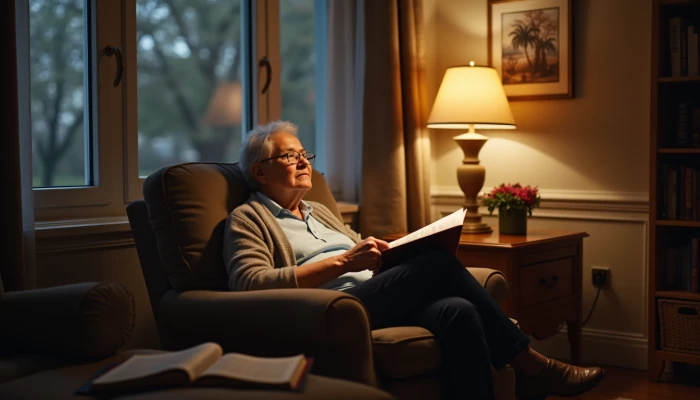
Safer Home Lighting for Older Adults Starts with What They Can Actually See
Lighting is easy to overlook until someone misses a step, misjudges the edge of a rug, or struggles to see clearly on the way to the bathroom at night. For many older adults, that is not just an inconvenience. It is a practical home safety issue.
Research and clinical guidance consistently connect poor lighting with higher fall risk, especially when visibility, contrast, and glare become harder to manage with age. That matters for families focused on fall prevention at home, because lighting affects more than brightness alone. It also affects depth perception, balance cues, and how quickly a person can notice obstacles.
The good news is that safer lighting usually starts with simple changes: improving light levels in high-risk areas, choosing light that supports daytime visibility, and reducing glare that can wash out edges and surfaces. This guide walks through those steps in a practical, beginner-friendly way.
The Visual System's Role in Balance and Fall Risk
Balance is not controlled by the legs alone. Older adults also rely heavily on visual information to stay upright, judge distance, and move safely through familiar spaces. Research on balance in aging adults notes that the visual system plays a major role in postural control, which helps explain why poor lighting can make ordinary movement feel less steady.
When lighting is too dim, several problems can happen at once. A person may have more trouble seeing the edge of a step, judging the height of a tub wall, or noticing clutter in a hallway. Low contrast can make a light-colored object disappear against a light floor. Shadows can also make a flat surface look uneven.
Common vision-related lighting problems include:
- Reduced depth perception on stairs and thresholds
- Difficulty detecting cords, pets, or small objects on the floor
- Lower contrast sensitivity, especially on pale floors or countertops
- Greater sensitivity to glare from shiny surfaces or exposed bulbs
- Slower adjustment when moving from a bright room into a darker one
This is one reason lighting should be treated as part of a broader home safety plan, not just a decorating choice. Inadequate light levels have been associated with more falls and more difficulty with daily activities in community-dwelling older adults.
For caregivers, a useful mindset is to watch for places where someone pauses, reaches for furniture, or avoids walking in low light. Those moments can reveal where visibility is not supporting safe movement.
A quick walk-through can help identify problem spots:
- Entryways where indoor and outdoor light levels change suddenly
- Hallways with dark stretches between fixtures
- Stairs where tread edges blend together
- Bathrooms used at night without low-level pathway lighting
- Bedrooms where the route from bed to the door is dim or cluttered
If an older adult already uses mobility aids, lighting still matters. A walker or cane does not remove the need to see floor changes clearly. Better illumination supports safer use of the space around the aid.
Brightness and Color Temperature Recommendations
Once you know where visibility breaks down, the next question is how much light is actually helpful. In practice, brighter is not always better if it creates glare or harsh contrast. The goal is enough light for the task, with a consistent feel from one area to the next.
Guidance commonly emphasizes stronger task lighting in higher-risk areas such as kitchens, bathrooms, and stairs. A practical target often cited for these spaces is about 300 to 500 lux for task visibility. That range can make grooming, cooking, medication organization, and step detection easier without relying on a single overly bright fixture.
Color temperature matters too. During the day, cooler white light in roughly the 4000K to 5000K range may improve clarity and alertness in active spaces. That can be helpful in kitchens, work areas, laundry rooms, and stair zones used during daytime hours. By contrast, very warm light below about 2700K may reduce contrast in pathways and staircases, making edges less distinct.
A simple room-by-room approach is often easier than trying to relight the whole house at once.
| Area | Lighting goal | Practical note |
|---|---|---|
| Hallways | Even, continuous illumination | Avoid bright spots followed by dark gaps |
| Stairs | Clear visibility of each tread and landing | Improve contrast and avoid deep shadows |
| Bathroom | Strong task lighting at sink, shower, and toilet area | Supports bathroom safety for seniors, especially at night |
| Kitchen | Brighter task lighting over prep and cooking areas | Helps with edges, spills, and small objects |
| Bedroom | Easy-to-reach lighting plus a visible path to the door or bathroom | Reduce the need to walk in darkness |
If you are deciding what to change first, start with the places where people do detailed tasks or walk when tired. That usually means:
- Bathroom
- Bed-to-bathroom pathway
- Stairs
- Kitchen work areas
- Main hallway and entry
Bathrooms deserve special attention because many falls happen during transfers, turning, and nighttime trips. Better overhead and task lighting can work alongside other bathroom safety for seniors measures such as grab bars for seniors and shower chairs for seniors. Lighting does not replace those supports, but it helps people see where to step, where to reach, and where water may be present.
If current lighting feels uneven, try to improve consistency between connected spaces. A brightly lit living room leading into a dim hallway can be harder to navigate than two moderately well-lit spaces with a smoother transition.
Reducing Glare in Key Areas
Glare is one of the most frustrating lighting problems for older adults because a room can seem bright enough and still be hard to use safely. Light reflecting off polished floors, glossy counters, mirrors, or uncovered bulbs can wash out detail and make surfaces harder to judge.
This is why glare reduction is a practical part of fall prevention at home. The aim is not only to add light, but to make that light easier on the eyes.
Start by checking for these common glare sources:
- Exposed bulbs visible from a seated or standing position
- Shiny tile, polished stone, or glossy flooring near pathways
- Bright fixtures reflected in mirrors or glass shower doors
- Strong daylight creating harsh contrast near entries or windows
- High-mounted lights that shine directly into the eyes on stairs or in living spaces
Several practical adjustments can help:
- Choose shaded or diffused fixtures instead of bare bulbs
- Use matte or lower-sheen finishes when updating floors or walls
- Position fixtures so light falls on the walking surface, not into the eyes
- Consider lower fixture placement where direct glare is a recurring issue
- Add motion-sensor lighting in hallways, bathrooms, and stair approaches so spaces do not suddenly go dark
- Use window coverings that soften daylight without making the room too dim
This checklist can help families prioritize changes:
- Can you clearly see the floor from one end of the hallway to the other?
- Are stair edges easy to distinguish in daytime and at night?
- Does any bulb shine directly into the eyes when approaching a room?
- Do bathroom surfaces reflect light so strongly that details disappear?
- Is there automatic or easy-to-reach light for nighttime trips?
- Do transitions between rooms feel gradual rather than abrupt?
Glare control is especially important near stairs, bathrooms, and entries. On stairs, direct glare can flatten the appearance of treads. In bathrooms, reflections from wet or glossy surfaces can hide puddles or edges. At entrances, strong outdoor light followed by a dim interior can briefly reduce visibility while the eyes adjust.
If a home needs more than bulb changes or fixture repositioning, it may be worth asking an occupational therapist, certified aging-in-place professional, or licensed lighting professional to assess the layout. That is particularly helpful when someone has low vision, frequent nighttime waking, or a history of falls.
Conclusion
Safer lighting is not about making every room as bright as possible. It is about helping an older adult see walking surfaces, judge distance, and move through the home with fewer visual obstacles.
The most useful strategy is usually a combination of steps:
- Improve task lighting in bathrooms, kitchens, and stairs
- Aim for practical brightness levels in high-risk areas
- Use daytime light that supports clarity and contrast
- Reduce glare from shiny surfaces and exposed bulbs
- Add motion-sensor or easy-access lighting for nighttime routes
These changes can support independence and make daily routines easier, but they do not guarantee that falls will not happen. If lighting problems are part of a larger safety concern, consider a fuller home safety assessment. An occupational therapist or qualified lighting specialist can help tailor solutions to the person, the home layout, and any vision or mobility limitations.