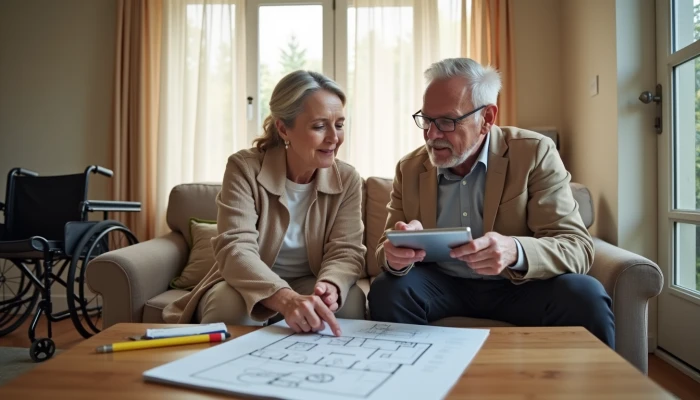
When to Seek Professional Help for Home Modifications
Deciding whether an aging parent needs professional help with home changes can feel unclear. Many families notice small problems first: a missed step, trouble getting out of the tub, or a hallway that suddenly seems too dim or crowded. The challenge is knowing when a simple cleanup is enough and when a more formal assessment is the safer next step.
Professional home modifications for seniors are not only about major construction. They start with understanding how a person moves through the home, where daily tasks are becoming harder, and which risks may be building over time. Guidance from occupational therapy and aging-in-place research commonly emphasizes matching the home to the person's actual abilities rather than making assumptions.
This guide walks through the main warning signs, a step-by-step evaluation process, and how families can work with the right professionals without overreacting or waiting too long.
Recognizing Red Flags for Professional Home Modification Needs
Some home safety issues are easy to spot, but others show up through behavior. A parent may not say, "I need help with the house." Instead, you may notice that they avoid stairs, stop using a shower, or hold onto furniture while walking from room to room.
These patterns matter because they can signal a mismatch between the home and the person's current mobility, balance, strength, vision, or judgment. That does not automatically mean a major renovation is needed, but it does suggest that a professional assessment may be worthwhile.
Common red flags include:
- Frequent tripping, slipping, or near-falls
- A recent fall, especially in the bathroom, bedroom, or on stairs
- Holding onto walls, counters, or furniture to move around
- Difficulty stepping into a tub or shower
- Trouble getting on or off the toilet or out of bed
- Avoiding parts of the home because they feel hard to use
- Reaching unsafely for items in high cabinets or low storage areas
- Poor lighting, cluttered walkways, loose rugs, or cords across paths
- Changes in memory or judgment that affect safe use of the home
It also helps to look beyond falls alone. If your parent is struggling with dressing, bathing, cooking, or carrying items safely, the home may no longer support daily routines well. In bathroom safety for seniors, for example, difficulty transferring in and out of the tub or toilet often points to a need for more than a general cleanup.
A useful rule of thumb is this: when a problem is repeated, affects daily function, or involves a high-risk area like stairs or bathing, it is reasonable to consider professional input rather than relying only on informal fixes.
Step-by-Step Evaluation Process for Home Safety
Before calling a professional, families can do a basic review to organize what they are seeing. This is not a substitute for a formal assessment, but it helps you describe concerns clearly and avoid vague conversations like "the house just seems unsafe."
Use a simple room-by-room process.
- Walk through the home during normal routines.
Watch how your parent actually moves through the space in the morning, at mealtimes, and before bed. Pay attention to where they pause, brace themselves, rush, or avoid an activity.
- Start with high-risk rooms.
Focus first on the bathroom, stairs, bedroom, entryway, and kitchen. These areas often combine movement, transfers, water, poor visibility, or carrying items.
- Note task-specific problems.
Document what is hard, not just where it happens.
- "Needs both hands on sink to stand from toilet"
- "Leaves laundry at bottom of stairs"
- "Stops using shower and sponge-bathes at sink"
- "Cannot reach everyday dishes without stretching"
- Look for compensatory behaviors.
These are workarounds people use when a space no longer fits their abilities.
- Furniture surfing
- Using towel bars or door frames for support
- Sleeping downstairs to avoid stairs
- Wearing shoes indoors for traction
- Leaving lights on all day because switches are hard to reach or rooms are dim
- Use a basic home safety checklist for elderly parents.
A practical checklist can help you review each room consistently.
| Area | What to look for |
|---|---|
| Bathroom | Slippery surfaces, difficult tub entry, low toilet height, poor lighting |
| Bedroom | Unsafe transfers, clutter near bed, hard-to-reach lamps or switches |
| Kitchen | Reaching hazards, unstable step use, crowded walkways, poor task lighting |
| Stairs and halls | Missing hand support, worn surfaces, dim lighting, objects on steps |
| Entryways | Uneven thresholds, weather-related slip risks, hard-to-manage doors |
- Write down patterns over one to two weeks.
A single awkward moment may not mean much. Repeated difficulty usually tells you more. This record can also help if multiple family members are involved and see different things.
- Decide whether the issue is housekeeping, equipment use, or a true modification question.
Some concerns involve organization or maintenance. Others involve mobility, transfers, cognition, or structural barriers that call for professional assessment.
This process creates a practical senior fall prevention checklist for your household. More importantly, it gives a future assessor specific information about what is happening, where it happens, and how often.
Collaborating with Interdisciplinary Professionals
When the home needs go beyond basic decluttering or routine maintenance, families often benefit from a team approach. Research and practice guidance commonly point to interdisciplinary collaboration because home safety problems are rarely only structural or only medical.
An occupational therapist is often a strong starting point. OTs typically assess how a person performs daily tasks in the actual home environment. That may include transfers, bathing, toileting, kitchen use, walking paths, sensory issues, and cognitive or judgment concerns. Their role is to connect the person's abilities with the demands of the space.
Other professionals may be involved depending on the issue.
- Occupational therapist: functional assessment, safety risks, daily activity barriers, recommendations tailored to the person
- Contractor or builder: installation and construction work that must be done safely and to code
- Architect or design professional: larger layout changes, accessibility planning, circulation, and structural redesign
- Social worker or care manager: care planning, service coordination, local resources, and family decision support
- Primary care or rehabilitation clinician: medical context when changes in function need clinical follow-up
A simple collaboration sequence can help.
-
Gather your notes from the home review.
-
Schedule a professional assessment, often beginning with an occupational therapist when function and safety are the main concerns.
-
Ask for recommendations tied to specific tasks, such as bathing, toileting, stair use, or meal preparation.
-
Separate recommendations into categories:
- Immediate safety concerns
- Changes that require licensed installation or construction
- Changes that may depend on health status, caregiving support, or budget
- Confirm who is responsible for what.
The OT may identify needs, but a contractor handles construction. A social worker may help coordinate services, but not design structural changes. Clear roles reduce confusion.
Families should also ask practical questions during this process.
- What problem is this change meant to address?
- Is the issue related to mobility, cognition, vision, endurance, or layout?
- Does this require a licensed professional?
- What should be prioritized first if not everything can be done at once?
This kind of teamwork helps keep home modifications for seniors individualized. It also reduces the risk of making changes that do not match the person's real daily needs.
When to Prioritize Professional Intervention
Some situations call for prompt professional input rather than continued observation. The goal is not to create alarm, but to recognize when waiting may leave an important risk unaddressed.
Prioritize professional assessment when any of the following apply:
- There has been a fall or repeated near-falls at home
- Stair use has become unreliable or frightening
- Bathing or toileting now requires unsafe improvising
- The person is showing confusion, poor judgment, or reduced safety awareness
- A change would involve structural work, plumbing, or electrical changes
- Family members disagree because the situation is no longer easy to judge informally
A recent fall is especially important because it may reveal both personal and environmental factors. Professional assessment can help sort out whether the main issue is balance, transfer technique, layout, lighting, surface conditions, or a combination.
Cognitive changes also raise the urgency. If a parent forgets steps in a routine, misjudges distances, leaves hazards in walkways, or cannot recognize unsafe conditions, the home may need a more formal review. In these cases, the question is not only whether the space is accessible, but whether it supports safe decision-making.
Use this quick decision guide.
| Situation | Reason to seek professional help soon |
|---|---|
| Fall in bathroom or on stairs | High-risk area with potential transfer or access problems |
| Furniture surfing or wall-bracing | Suggests mobility mismatch with layout or support needs |
| Trouble with bathing or toilet transfers | Daily essential tasks with elevated injury risk |
| Memory or judgment changes | Safety awareness may be reduced |
| Planned construction or wiring changes | Requires qualified design and licensed installation |
If you are unsure, it is reasonable to start with an assessment rather than a construction plan. A good evaluation can help families prioritize what matters most and avoid unnecessary or poorly matched changes.
Conclusion
The right time to seek professional help is usually when home difficulties become repeated, task-specific, or clearly tied to safety. Families do not need to wait for a crisis, but they also do not need to assume every concern requires major work.
A practical approach is to observe routines, document red flags, and bring in the right professionals when function, judgment, or the home environment no longer fit well together. Occupational therapists, contractors, architects, and care-planning professionals can each play a role, depending on the problem.
The most useful home modifications are the ones matched to the person, the home, and the daily tasks that matter most. Thoughtful early planning can support comfort and independence while helping families make decisions with more clarity.